A colleague is leaving, a friend has a birthday coming up, or someone is having a baby, and somebody sends a message: "Shall we all chip in for something?" Within an hour there are twelve replies, three different gift ideas and no idea who has actually paid.
Group gifts and shared parties are small amounts of money, but they cause more awkwardness than their size deserves. People worry about looking cheap, about being asked for too much, or about being the one who has to chase everyone. A few simple habits take most of that away.
The short version: agree the total budget first, turn it into a suggested amount per person, let people give less if they need to, collect before you buy, and tell the group exactly what was spent.
Start with the budget, not the gift
The most common mistake is to pick a gift and then discover what it costs. Flip the order. Decide what the group is comfortable spending in total, then look for something that fits. When people see a total and a number of contributors, the amount per person feels reasonable rather than random.
If the group is mixed, for example colleagues on different salaries or friends at different stages of life, set a modest target. A smaller budget that everyone can join is better than an impressive one that leaves some people out.
Three ways to share the cost
1. An equal share
Divide the total by the number of people. It is simple and transparent, and it works well when everyone is in a similar position. Round the result up to a friendly number so nobody has to send odd amounts.
2. A suggested amount, with room to give less
Say "we are suggesting $20 each, but give whatever suits you." Most people give the suggested amount, a few give a bit more, and those on a tight budget can give less without having to explain. This is usually the kindest option for workplaces and large groups.
3. The host fronts the cost
For a party, one person often buys everything, such as food, a cake and decorations. The others reimburse them. It is the easiest approach logistically, provided the host does not end up out of pocket for weeks.
Worked example: a group gift
Eight colleagues want to buy a farewell gift costing $150.
Equal share: $150 ÷ 8 = $18.75 each. Asking for $18.75 is awkward, so most groups round up to $19 or $20.
Suggested amount of $20:
- If all eight give $20: 8 × $20 =
$160 - The gift costs $150, which leaves
$10 - That $10 pays for a card and wrapping, or goes towards a small extra such as chocolates
If a couple of people can only give $10, the gift is still covered by the others' extra, because the group's total is $160 against a $150 gift. That is the benefit of rounding up: a small cushion makes the whole thing relaxed.
Worked example: a birthday dinner for the guest of honour
Ten friends go out for a birthday dinner. The total bill, including tax and tip, is $270. The birthday person should not pay for their own celebration, so the other nine split it.
Guests share the whole bill:
- $270 ÷ 9 guests =
$30 each - Compared with splitting ten ways: $270 ÷ 10 = $27 each, so each guest pays
$3 moreto cover the honoree
If people ordered very different amounts, split the dinner by what each person ordered and divide the guest of honour's share equally among the others. The restaurant bill splitter does this automatically, including sharing tax and tip in proportion.
Worked example: a host who fronts a party
One friend buys $120 of food, decorations and a cake for a surprise party. Six friends are organising it, including the host.
- Equal share: $120 ÷ 6 =
$20each - The host pays $20 of their own money, so the other five owe
5 × $20 = $100in total - Check: $100 + the host's $20 = $120
How to collect the money without chasing people
- Choose one organiser. One person collects and keeps notes. Spreading it across several people leads to confusion.
- Set a deadline before you buy. Collect first, then purchase. Being left to cover someone else's share is what turns a nice gesture into a chore.
- Keep it private. Ask people to send their contribution directly to the organiser rather than writing it in the group chat, so nobody feels watched.
- Be clear about the exact total. A message like "$150 gift, $10 for the card, 8 of us" is easier to trust than a vague request.
- Share the result. After buying, post the final total spent and what happened to any leftover money.
What to do with extra or missing money
Extra: if you collect more than needed, add a card, flowers or wrapping, or carry the amount towards the next group gift and say so. Refunding tiny amounts is rarely worth it.
Missing: if you are a little short, the organiser can top up a small amount, or the group can agree a quick extra request. Avoid chasing individuals. A short, friendly reminder to the whole group is enough.
Keeping it comfortable at work
Workplace collections can feel like pressure, especially for newer staff or people on tighter budgets. Make it optional, suggest a range rather than a fixed price and never mention who did not contribute. Many people simply want to be included at whatever level suits them, and a relaxed approach makes them far more likely to join in.
Three ways to share, at a glance
| Method | Works best when | Watch out for |
|---|---|---|
| Equal share | Everyone is in a similar position | Someone stretching their budget to match |
| Suggested amount, give what suits | Large groups and workplaces | The organiser must not publish who gave what |
| The host fronts the cost | A party with many small purchases | The host being out of pocket for weeks |
The gift example, in the calculator
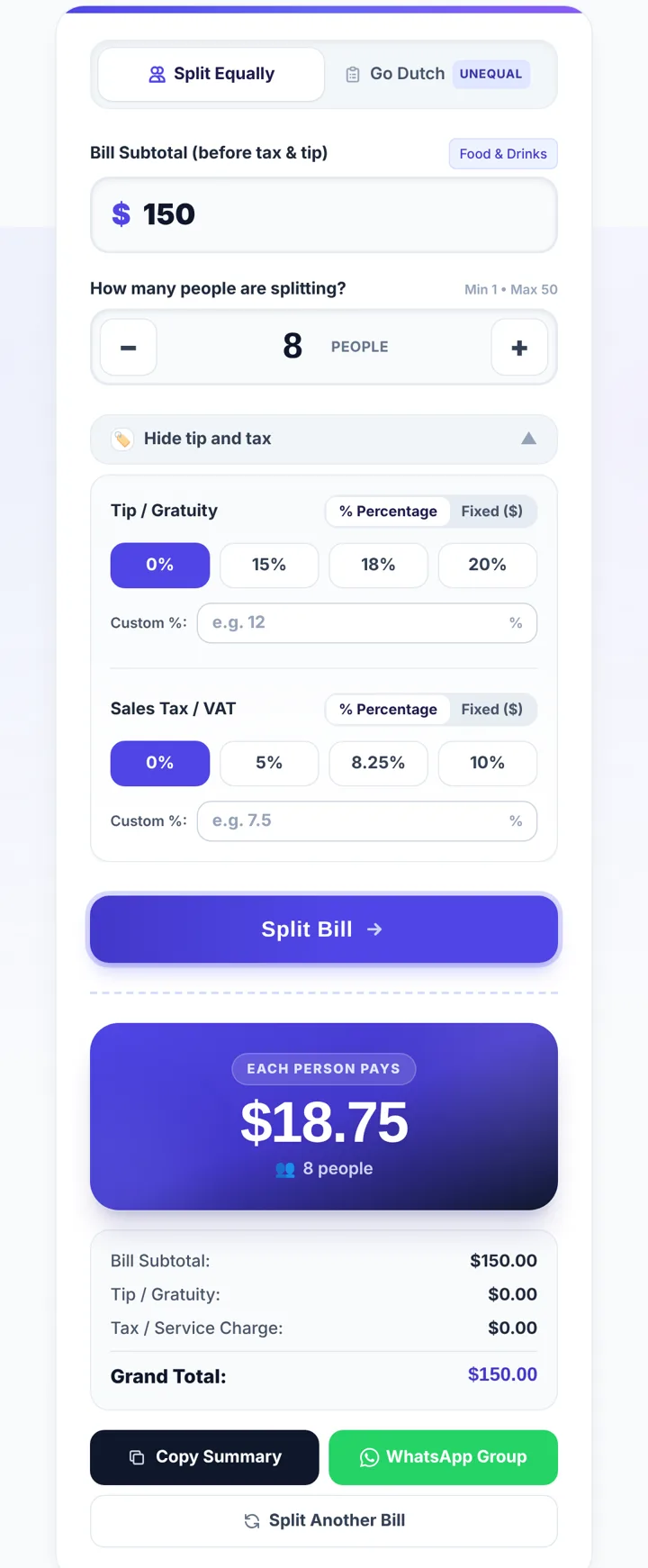
Eight colleagues, a $150 gift, no tip and no tax. The calculator returns $18.75 each, which most groups round up to $20. As shown above, that leaves $10 for a card and wrapping.
Messages you can copy
- “We are putting together a farewell gift for Sam, with a budget of around $150. A suggested amount is $20 each, but please give whatever suits you.”
- “I am collecting until Friday and will buy the gift on Saturday. You can send your share to me directly.”
- “All done! The gift came to $140 and the card was $10, so we are exactly on budget. Thank you, everyone.”
Before you start collecting
- Name one organiser.
- Agree the total budget and the deadline.
- Decide what happens to any leftover money.
- Collect first and buy later.
Do the sums in seconds
For birthday dinners and group meals, the free bill splitter lets you divide a restaurant check equally or item by item, with tax and tip shared in proportion. It runs in your browser, needs no account and nothing you enter is stored.
Open the Restaurant Bill Splitter →
This article is general information, not legal or financial advice. Related reading: How to split a restaurant bill fairly, how to split a group trip bill and how much to tip at a restaurant.
Frequently Asked Questions
How much should each person chip in for a group gift?
Decide the total budget first, divide by the number of people and round up to a friendly number. Then say that any amount is welcome, so people who cannot afford the suggested figure can give less without being singled out.
Should the guest of honour pay at their own birthday dinner?
Usually not. The common approach is for the other guests to share the honoree's meal along with their own, so the total bill is divided by the number of guests who are not the guest of honour.
Who should collect the money for a group gift?
One person who volunteers and is trusted by the group. They set a deadline, collect before buying anything and share the final total spent, including any leftover, so everyone can see where the money went.
What if we collect more than the gift costs?
Put the extra towards a card, wrapping or a small add-on such as flowers, or keep it for the next group gift and tell everyone you are doing so. Refunding a few cents or dollars to each person is rarely worth the effort.
How do we keep a workplace collection from feeling like pressure?
Make it optional, give a suggested range instead of a fixed price, and never share who did or did not contribute. A private way to give, such as sending money to the organiser directly, helps.
Last reviewed: