
Picture this: You’ve just finished a fantastic dinner with five close friends. The conversation was buzzing, the food was great, and everyone’s basking in that post-meal glow. Then it happens. The server glides over, drops a sleek black leather folder in the middle of the table, and murmurs those four fateful words: "Whenever you're ready."
Instantly, the air leaves the room. That warm banter vanishes. Five functioning adults with college degrees turn into panicked accountants staring at a slip of thermal paper like it’s an unexploded firework. Someone squints at the subtotal. Someone else checks their lock screen like they just got urgent breaking news. And then, right on cue, the friend who downed three mezcal cocktails and ordered the bone-in ribeye chirps up: "Hey, why don't we just split it evenly?"
Your stomach drops. Because you? You had tap water and a side salad.
Welcome to the ultimate social minefield of modern dining: figuring out how to split a restaurant bill without ruining friendships, feeling like an absolute cheapskate, or funding someone else's expensive bar tab. Let’s break down how to handle this like civilized grown-ups—with real math, zero passive-aggressive group texts, and your dignity intact.
Why Bill Splitting Turns Everyone Weird
Let's be real: nobody enjoys doing arithmetic in public, especially after two slices of pizza and a glass of wine. But the awkwardness of check-splitting isn't really about numbers. It's about what money represents in social circles: comfort, boundaries, and fairness.
Money remains awkward to talk about openly. When the check lands, everyone at that table balances their private financial reality against the pressure to seem easygoing. Maybe Sarah just had an unexpected car repair and planned her evening down to the exact dollar. Maybe Dave has disposable income and doesn't care whether dinner costs thirty bucks or eighty. When Dave says, "let's throw down forty each," he thinks he’s saving everyone time. Sarah, meanwhile, feels a spike of quiet anxiety—yet stays silent because she doesn't want to be labeled "difficult."
That's the fundamental problem with group dining: lighter spenders get forced into an uncomfortable corner. If you speak up and say, "Actually, my soup was only twelve dollars while your steaks were forty," you worry you look petty. If you keep quiet, you pay an extra twenty dollars you didn't budget for, stewing about it the entire ride home.
Add in sales taxes, shared appetizers nobody quite remembers claiming, and that one person who swears they'll "Venmo you tonight" (and definitely won't until you poke them three days later), and resentment builds. There's a much better way to handle it.
The 3 Ways to Split a Check (And When to Use Each)
Over the years, diners have developed three main ways to handle a restaurant tab. Each has a specific purpose. Here is how they actually play out.
Method 1: The Equal Split (The "Quick Division")
The Idea: Take the grand total at the bottom of the receipt—food, drinks, tax, tip, everything—and divide it cleanly by the number of diners seated around the table.
The Math:
Total bill: $240 (tax & tip included)
Diners: 6
Each person pays: $240 / 6 = $40.00
When it’s great:
- Everyone ordered similar items (everyone got a sandwich and a soda).
- It's a fast-casual spot where menu prices vary by only a dollar or two.
- You’re rushing to catch a movie or train and literally lack four minutes to analyze line items.
- The whole table has similar budgets and agreed beforehand to divide evenly.
When it fails:
- One person had an appetizer as dinner ($9) while another had prime steak ($45).
- Half the table drank cocktails and the other half drank water.
- Someone arrived late, ate two leftover fries, and gets handed a $35 bill.
The Awkward Conversation You’ll Have:
"Wait, so I owe $45 for avocado toast and black coffee? Are we paying the kitchen staff's mortgage?"
The Rule of Thumb: Great for speed, terrible for fairness. Only use this if everyone's orders stayed within 10% of the table average.
Method 2: Going Dutch (The "Itemized Breakdown")
The Idea: Everyone pays for exactly what they ordered. You take the receipt, note each person's dishes, and allocate tax and tip proportionally based on what each person spent.
What does "proportional" mean in practice? Here is where most people stumble: they tally their food, then toss in a random three-dollar tip or guess the tax. That leaves whoever pays the card short every single time. A proper "Go Dutch" calculation finds each person’s share of the food subtotal, then applies that same percentage to the tax and tip.
Real Example with Numbers:
Food Subtotal: $100 | Tax (8%): $8 | Tip (20%): $20 | Total: $128
- Alex's Order: Burger ($20) → 20% of the food subtotal. Alex pays 20% of the total:
0.20 * $128 = $25.60. - Jordan's Order: Steak & 2 Drinks ($80) → 80% of the food subtotal. Jordan pays 80% of the total:
0.80 * $128 = $102.40. $25.60 + $102.40 = $128.00. Perfectly balanced to the penny. Zero drama.
When it’s great:
- Significant differences in spending (some had alcohol, some had tap water).
- Work colleagues or acquaintances dining together where you don't share deep social history.
- Anyone dining on a strict personal budget who needs exact numbers.
When it’s tedious:
- Trying to calculate it by hand on a napkin while the server waits. (Instead, use our free restaurant bill splitter—it handles proportional tax and tip instantly).
The Rule of Thumb: The gold standard of fairness. Nobody pays for anyone else's meal. If your group values fairness and peace of mind, use this.
Method 3: The Hybrid Split (The "Food vs. Drinks" Balance)
The Idea: Split the food evenly across the table, but have anyone who ordered alcoholic drinks, specialty cocktails, or private desserts pay for their own drinks separately.
Why does this work so well? Because in most restaurant arguments, food prices aren't the problem—drinks are. Three cocktails in a city easily reach $50 to $60 before tax and tip. If two people at a four-person table drink martinis while the other two drink water, an equal split forces the sober diners to pay thirty extra dollars just for watching their friends drink.
How to do the Hybrid Split smoothly:
- Ask the server to keep drinks on a separate tab if possible, or circle the drink lines on the receipt.
- Have the drinking guests split the beverage total, plus beverage tax and tip, among themselves.
- Divide the remaining food total, food tax, and food tip equally across all diners.
The Awkward Conversation You Avoid:
You eliminate the painful "I didn't have any wine tonight..." throat-clearing conversation before it ever starts.
The Rule of Thumb: The best compromise for casual dinners with close friends. Fast, largely fair, and protects non-drinkers from footing the bar bill.
4 Common Dining Scenarios (And How to Handle Them Gracefully)
Theory is easy, but real dining rooms get messy. Here are four common situations and the exact words to use so you stay calm and polite.
Scenario 1: The "I Only Had a Salad" Dilemma
You watched your budget and ordered a twelve-dollar salad. The person opposite you ordered an appetizer, ribeye steak, and two glasses of wine. The check comes out to $260 for four people. Someone calls out: "Let's just throw in $65 each!"
What to do: Speak up immediately with a smile. The key is framing it around your own light order rather than criticizing what they ordered.
Say this:
"Hey everyone! Since I just had a salad and water tonight, I'm going to put down $18 to cover my dish, tax, and tip, and you guys can split the rest! That way you aren't stuck with my part."
You offered a clear number covering your food, tax, and tip generously, removed yourself from the equal pool, and kept the tone light. Nobody feels judged.
Scenario 2: The Shared Appetizer Question
Someone ordered nachos for the table. Four people ate enthusiastically. One person took a single chip. One person skipped it entirely due to a dairy allergy. Who pays?
The Golden Rule: If you ate a meaningful portion, you contribute. If someone abstained because of dietary restrictions or simply didn't want any, never pressure them to pay for your nachos. Divide the starter cost only among the guests who actually shared it.
Scenario 3: The Friend Leaving Early
Dinner is winding down, but dessert hasn't arrived. Mark checks his phone: "I've gotta catch my train! Here's thirty bucks, hope that covers it!" Mark dashes out. An hour later, the check shows his actual share was $46. Now the table has to cover his $16 gap.
How to avoid this: If someone needs to leave early, pull up a free bill split calculator before they stand up. Type in their items, calculate their exact share with tax and tip, and have them send the money right then. It takes thirty seconds and saves everyone from grumbling after they leave.
Scenario 4: "I'll Venmo You Later" (The Missing Payment)
One friend puts down their credit card. Three people reimburse them right away. One friend says, "My phone's dying, I'll send it when I get home." Two days later, nothing.
How to follow up without being passive-aggressive: Don't wait three weeks and send an irritated message. Send a friendly reminder the next morning with the exact amount and details.
Text this:
"Hey! Had such a great time yesterday. Whenever you get a minute today, here was your dinner share: $32.40. My Venmo is @username. Have a great week!"
Keep it factual, cheerful, and simple. Most friends aren't trying to avoid paying; they just got distracted.
Regional Tipping Customs You Should Know
Splitting checks gets trickier across different countries. What counts as standard generosity in one region can be confusing in another. Here is a quick reference guide:
1. United States (18–20% Standard)
In the US, servers rely heavily on tips. Leaving a gratuity is standard practice, not an optional bonus for rare occasions. The typical baseline is 18% to 20% of the pre-tax food total (higher for outstanding service). When splitting checks in America, verify whether parties of six or more already have an automatic gratuity added to the receipt. If an 18% gratuity is already included, avoid double-tipping by mistake.
2. United Kingdom (12.5% Service Charges)
In London and across the UK, receipts often include an "Optional Service Charge" (usually 12.5%). If that line is already on your receipt, you do not need to leave extra cash. If no service charge is listed, rounding up or leaving 10% to 12.5% for sit-down table service is customary. At pub counters where you carry your own drinks, tipping is generally not expected.
3. India (5% GST & Voluntary Service Charges)
Dining out in India includes specific tax rules: standard restaurants generally apply 5% GST (2.5% CGST plus 2.5% SGST). Many restaurants also add a 5% to 10% "Service Charge." Consumer protection guidelines clarify that restaurant service charges are voluntary. If you are satisfied with the service and the charge is included, no extra tip is necessary. If not included, leaving 7% to 10% in cash or card payment is common for attentive service.
See it in action: a real split
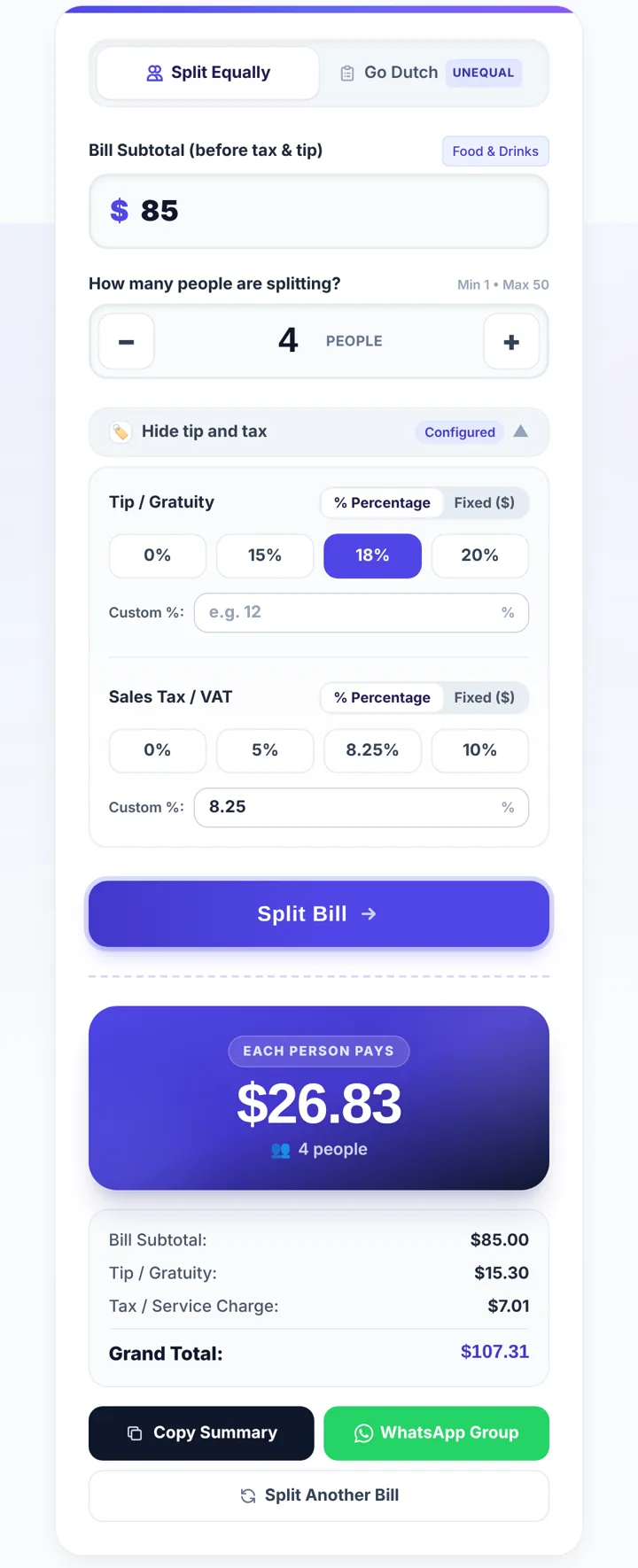
Here is the splitter on a typical case: an $85 check shared by four people, with 18% tip and 8.25% sales tax. The tip is $15.30, the tax is $7.01, the grand total is $107.31, and each person pays $26.83.
Messages you can copy
- “Could we ask for separate checks? Some of us only had a starter.”
- “Quick total: the bill was $107.31 with tip and tax, so $26.83 each. Sending you the details now.”
- “Friendly reminder about the dinner on Saturday. Your share was $26.83 when you have a moment.”
Stop Doing Math in Your Head: Use SplitOrDutch
We carry supercomputers in our pockets every day. Why spend ten minutes squinting at a receipt under dim restaurant lighting, trying to calculate percentages in your head while everyone else is talking about weekend plans?
That is why we created SplitOrDutch. It is a free, instant restaurant bill splitter and tip calculator built for real dining situations:
- No App Downloads: Opens directly in your phone browser. No large app downloads or store updates.
- No Sign-Ups or Accounts: Zero email registrations, passwords, or marketing messages. Open the page and calculate immediately.
- Equal or Go Dutch Modes: Divide a simple tab in two seconds, or switch to "Go Dutch" mode to list individual meals and drinks for each friend.
- Automatic Proportional Math: It divides shared taxes, service charges, and tips proportionally based on what each person spent.
- One-Click WhatsApp Summary: Tap one button to copy a clear, itemized breakdown ready to send into your group chat so everyone knows their share.
Next time the folder hits your table, open splitordutch.com, finish the split in sixty seconds, and get back to enjoying your friends. That's how dining out should be.
Splitting rent with roommates too? Read How to Split Rent Fairly Between Roommates.
Not sure how much to leave? See How Much to Tip at a Restaurant in the US.
Sources and further reading
- Distributing tips fairly: statutory code of practice (UK government). Explains how tips and service charges should be passed on to staff.
- Guidelines on the levy of service charge in hotels and restaurants (Central Consumer Protection Authority, India). States that service charge cannot be added to a bill automatically.
Tipping customs and rules change, so check the current rules where you are dining.
Frequently Asked Questions
Should you calculate tip on the pre-tax or post-tax bill total?
Etiquette standards consistently state that tips should be calculated on the pre-tax subtotal. Sales tax is a government charge, not a service provided by your restaurant server. While many diners calculate tip on the final total out of convenience, tipping on the pre-tax food amount remains the recognized standard.
Can we ask our server to split the check across multiple credit cards?
Yes, though it helps to be considerate. Most modern restaurant systems handle splitting across two or three cards easily. For larger groups of six or eight, asking a busy server to process numerous custom card amounts during peak dining hours causes noticeable delays. Having one or two guests pay the restaurant while others reimburse them via payment apps is usually much smoother.
What is the fairest way to split a bill when someone doesn't drink?
The Hybrid Split works best: separate the alcoholic drinks and their proportional tax and tip from the total. Diners who had drinks split that beverage portion among themselves, while everyone shares the food subtotal, tax, and tip equally. Non-drinkers avoid paying for wine or cocktails they never had.
What does "Going Dutch" actually mean?
The term "Going Dutch" refers to a dining arrangement where each person pays exclusively for what they individually ordered, rather than dividing the final bill evenly or having one person pay for the whole party.